
Crab Grilled Sandwich with Spinach and Feta
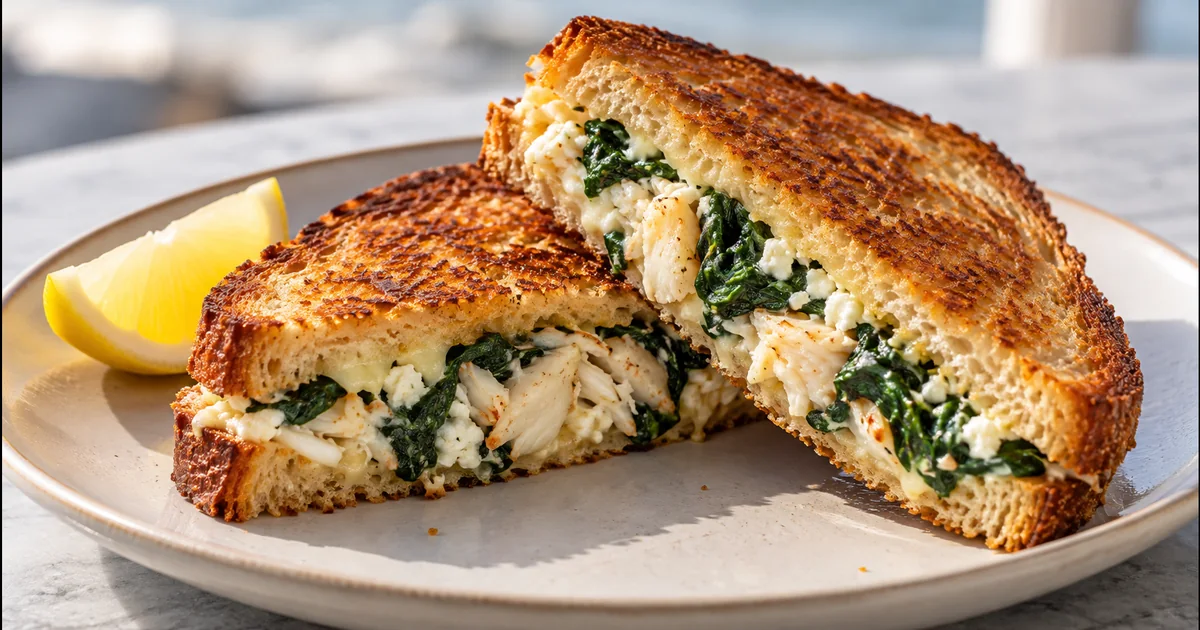
A crab grilled sandwich can carry seafood without turning into a heavy, loose crab dip between slices of bread. This version uses cooked crab, spinach that has been wilted and squeezed dry, a modest amount of feta for a salty accent, and mozzarella to bind the filling as it warms. It makes two substantial sandwiches. The crab remains visible in the filling; the cheeses support it rather than replacing it.
Start with cooked, ready-to-eat crab meat, not raw crab. Read the product label for refrigeration and use-by instructions, and pick through the meat for shell fragments before it goes into the sandwich.
Table of Contents
What a Crab Grilled Sandwich Filling Needs to Do
Moisture is the main practical problem in a seafood grilled sandwich. Cooked crab can carry liquid from its container; spinach sheds water as it wilts; a thick layer of sauce can soak bread before the cheese melts. Drain the crab gently, wilt the spinach separately, and squeeze the spinach after it cools enough to handle. You want a filling that holds together in a spoon, not one that flows across the cutting board.
The cheeses have different jobs. Feta brings tang and salt but does not stretch into a cohesive melted layer. Shredded low-moisture mozzarella helps bind the crab and greens. A tablespoon of mayonnaise and a teaspoon of lemon juice lightly dress the seafood; neither should form a pool in the bowl. Because feta and packaged crab may already be salty, the dressing does not add another measured spoon of salt. Taste only the ready-to-eat mixture with a clean utensil and use the actual product labels to judge seasoning.
Use four slices of sturdy sandwich bread of similar thickness, about two packed cups of raw baby spinach, eight ounces of cooked crab meat, one-quarter cup crumbled feta, and one-half cup shredded low-moisture mozzarella. The raw spinach volume is a shopping and prep guide; squeeze out water and distribute the wilted greens evenly. You also need one tablespoon of mayonnaise, one teaspoon of lemon juice, one tablespoon of olive oil for the spinach, and one tablespoon of softened butter for the outside of the bread. These amounts make two sandwiches with an evenly distributed filling.
Prepare the crab and spinach
Keep the crab refrigerated while you set up the pan and spinach. If the product is a refrigerated pasteurized container, it is not shelf-stable simply because it resembles a can. If it is commercially canned and shelf-stable unopened, transfer any unused portion to a covered container after opening and chill it. Follow the actual label for its storage period. A raw crab product belongs to a different cooking method and should not be substituted here.
Warm the olive oil in a skillet over medium heat. Add the spinach and stir just until it wilts, roughly one to two minutes. Move it to a plate to cool briefly, then press or squeeze out excess liquid. Chop it if long stems would pull the filling out when you bite into the sandwich. Wipe the skillet so moisture or stray leaves will not scorch during the bread-grilling step. This short spinach step is included in the cook time; no pre-cooked greens are assumed.
Drain the crab as needed without crushing it. Examine the meat for shell. Combine the crab, squeezed spinach, feta, mozzarella, mayonnaise, and lemon in a bowl, folding gently until the ingredients are distributed. The crab is already cooked, so there is no need to stir it into a paste. If the mixture looks visibly wet, check whether the spinach or crab needs more draining rather than adding unmeasured breadcrumbs. A small amount of moisture is normal, but the bread must remain capable of browning.
Grill the sandwiches evenly
Divide the filling across two bread slices and spread it to a roughly even thickness, stopping a little short of the edges. Top with the remaining slices. Spread softened butter thinly over the outer faces. Heat a clean skillet over medium-low heat and add the sandwiches. A moderate heat gives the center time to warm while the bread browns. Cook about four to five minutes on the first side, turn carefully with a broad spatula, and cook another four to five minutes. Adjust the heat if the bread darkens before the middle is hot.
Because this is a mixed seafood filling, check the center rather than judging only by melted cheese or golden bread. The reheating target is 165°F (74°C) at the center, consistent with official guidance for reheated leftovers and mixed dishes. Probe into the filling from the side without touching the hot pan. A thick sandwich may need a little longer under a loose lid at low heat; a thin sandwich may be ready sooner. Remove it once the filling is heated through to the target, rest briefly, and cut with a clean knife.
The planning timeline is ten minutes to gather, drain, mix, and assemble, plus roughly twelve minutes to wilt the greens and grill, for about twenty-two minutes total. This assumes cooked crab and ordinary sandwich bread. Product temperature, bread thickness, moisture, and pan heat can change the actual cooking time. The temperature endpoint is more useful than a claim that every sandwich finishes at precisely the same minute.
How to serve it
Serve the sandwich promptly so the bread keeps its crisp surface. A simple cucumber salad or raw vegetable sticks offer contrast without adding another creamy component. If you want a sharp note, a lemon wedge can be offered at the table, but avoid soaking the toasted bread in juice. A side of tomato soup may be appealing, though the sandwich should stand on its own as a seafood lunch or light dinner.
This is a two-sandwich yield, not a promise that each person will want exactly one sandwich regardless of the meal. If the bread slices are unusually small, divide the filling according to their size and check that the center reaches the same endpoint. If you are serving a group, cook in batches rather than overcrowding the pan. Holding the first batch for a long period on the counter would compromise both the texture and safe handling.
Substitutions that preserve the idea
Cooked lump crab gives larger visible pieces; cooked claw meat is usually smaller and may blend more readily into the filling. Either can fit the eight-ounce amount if drained and handled according to its package. A different melting cheese can change salt and moisture, so this version specifies low-moisture mozzarella. Feta is a flavor accent here; doubling it may overwhelm the crab and make the filling saltier without improving the melt.
Another sturdy bread can be used, but a very airy loaf may compress under the moist filling and a very thick artisan slice may brown before the middle heats. Keep the slice sizes consistent. Frozen spinach is possible only if thawed, heated as needed, and squeezed very thoroughly; its volume after thawing is not equal to two cups of fresh leaves, so this measured version does not assign a one-for-one quantity. If replacing crab with another seafood, make a separate measured recipe rather than retaining a crab-focused title and card.
Mayonnaise is a small binder, not a substitute for heating the filling. If your crab has a pronounced packing liquid, drain it before assessing whether the tablespoon is appropriate. Avoid adding raw onion or large tomato pieces inside the sandwich without reviewing moisture and cooking time. These ingredients are better served as a crisp side than slipped into the filling without measurement.
Troubleshooting the pan
If the bread browns too quickly, reduce heat and continue gently. Pressing hard with a spatula can squeeze liquid toward the crust and force crab from the edges; use only light contact to settle the sandwich. If the filling escapes, check whether it was spread too close to the edge or the spinach was left wet. A lid can help retain heat briefly, but lift it if steam begins to soften the bread. One careful turn is easier than repeated flipping of a thick seafood filling.
A center that still feels cool is not fixed by a darker crust. Use the thermometer and lower the heat. If the cheese has melted but the center is not at 165°F (74°C), keep cooking gently. Conversely, do not continue simply to achieve a darker photograph once the bread is toasted and the center is properly heated. The temperature check separates the safety decision from the appearance of the exterior.
Refrigeration and leftovers
Refrigerate cooked crab and assembled leftovers promptly. FoodSafety.gov recommends chilling perishable food within two hours, or one hour above 90°F (32°C), and reheating leftovers to 165°F (74°C). Place leftovers in a shallow covered container at 40°F (4°C) or below, follow any shorter crab-package instruction, and use the general cooked-leftover window of three to four days only when the product label does not require earlier use. The bread will soften after refrigeration, so quality may decline sooner than the safety window.
For reheating, use a skillet over gentle heat and check the middle; a microwave may heat the filling unevenly and soften the toast. Do not repeatedly warm and chill the same sandwich. If preparing the filling ahead, keep it covered and refrigerated, then assemble and grill when ready. The stated prep and total times do not include advance chilling, defrosting, or cooking raw crab.
Related: If you have more crab to use, this cowboy crab dip offers a different warm, shareable option.
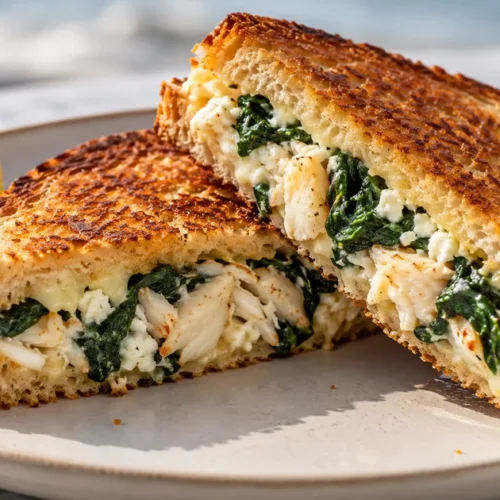
Crab, Spinach and Feta Grilled Sandwich
Ingredients
- 8 oz cooked, ready-to-eat crab meat drained and picked over
- 2 packed cups raw baby spinach
- 1 tbsp olive oil
- 1/4 cup crumbled feta
- 1/2 cup shredded low-moisture mozzarella
- 1 tbsp mayonnaise
- 1 tsp fresh lemon juice
- 4 slices sturdy sandwich bread
- 1 tbsp softened butter for bread
Instructions
- Wilt the spinach in olive oil for 1–2 minutes, cool briefly, then squeeze out its moisture.
- Drain and inspect the already-cooked crab. Fold it with the spinach, feta, mozzarella, mayonnaise, and lemon juice.
- Divide the filling between two bread slices, cover with the remaining slices, and butter the outer faces.
- Grill in a medium-low skillet about 4–5 minutes per side, adjusting heat to avoid burning and checking the center of the heated mixed filling reaches 165°F (74°C).
- Rest briefly, cut, and serve.
Notes
Frequently asked questions
Can I use canned crab?
Use a commercially prepared product that is labeled cooked or ready to eat, and observe its storage instructions. Some tins are shelf-stable unopened, while pasteurized refrigerated crab must remain cold before opening. Drain and inspect for shell fragments. Do not assume every container with a metal lid has the same handling requirements.
Why are there two cheeses?
Feta adds a salty, tangy accent and mozzarella supplies the melt that helps hold the filling. Keeping the amounts measured lets the crab remain the main ingredient. Feta alone may not bind the greens and crab as effectively.
Can I use raw spinach directly?
This measured version wilts and squeezes the spinach before assembly. Raw leaves can release water as the sandwich cooks and make the bread soggy. A raw-spinach version would need a separate quantity and a cooking check, so it is not presented as equivalent.
Is the crab being cooked in the sandwich?
No. The formulation starts with already-cooked crab and heats the assembled sandwich. Raw crab needs a different, validated seafood cooking method. The 165°F center target applies to this mixed reheated filling and is not a substitute for choosing the correct product state.
Can I make four sandwiches by doubling everything?
The recipe makes two sandwiches. Doubling the ingredients suggests four similar portions if the bread and filling are divided evenly, but the pan may need batches and the timing per sandwich remains dependent on thickness and heat. Check the center of each batch.
A seafood sandwich with a clear method
This method works when the crab is already cooked, the spinach is drained, the filling stays measured, and the skillet heats the middle without burning the bread. Those decisions make the sandwich distinct from a plain grilled cheese or a spoonable crab dip.