
Seafood Doenjang Jjigae with Shrimp and Clams
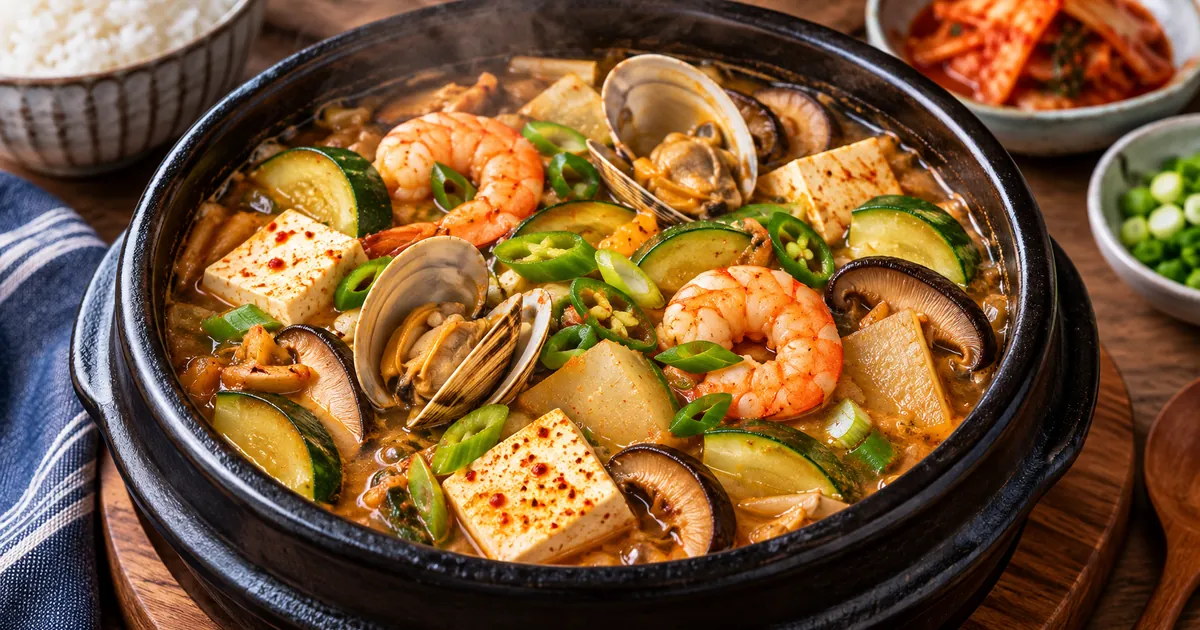
Seafood doenjang jjigae is a savory Korean-style stew built around doenjang, a fermented soybean paste that gives the broth its defining flavor. This version pairs that broth with shrimp and clams, then adds tofu, Korean radish, zucchini, mushrooms, and scallions. The seafood goes in toward the end so the vegetables have time to soften without forcing the shrimp to simmer throughout the process. It is a four-serving recipe for people who want a clear sequence and measured quantities rather than an undefined assortment of seafood added to a pot.
This is a specific seafood variation, not a claim that one combination is the only authentic Korean method. Doenjang jjigae has many household and regional approaches, and both the concentration of soybean paste and the amount of liquid vary. Here the paste is measured against unsalted broth, which gives the cook a defined starting point while leaving the ingredient labels and the actual seasoning strength in view. The preparation uses live, cleaned clams and raw peeled shrimp. If either product is unavailable or arrives in a different form, the instructions and timing need to be adjusted rather than treated as interchangeable without explanation.
The stated 45-minute planning window consists of approximately 20 minutes of active preparation and 20 to 25 minutes of stovetop cooking. It assumes that the stock is ready and that any supplier-required clam purging has already been completed. It does not include making anchovy-kelp stock from scratch, thawing frozen shrimp, or extended shellfish cleaning. These exclusions matter more to a useful recipe than a promise that every shopping and preparation situation will fit the same clock.
Table of Contents
What gives seafood doenjang jjigae its flavor
Doenjang is the central seasoning. Three tablespoons in four cups of unsalted anchovy-kelp broth provide a measured base for four smaller bowls. Choose a Korean fermented soybean paste labeled doenjang rather than silently substituting another fermented paste. Products differ in strength and sodium, so the recipe does not add an automatic dose of salt at the beginning. Taste the completed broth after the seafood has cooked, using the label and the paste’s natural saltiness as the guide; the standard card stays consistent even if someone decides to adjust their own serving.
Prepared, unsalted anchovy-kelp stock contributes another seafood element before the shrimp and clams enter the pot. A cook who uses water instead will still have doenjang as the dominant seasoning, but the finished broth will not be identical. For this measured version, use the specified prepared stock. Confirm that it contains no unlisted allergens and avoid a heavily salted instant stock that would turn a controlled seasoning ratio into guesswork. Because anchovy stock contains fish, the final allergen guidance should name fish along with the shellfish and soy in this recipe.
The order of additions makes the broth easier to control. Radish and onion can soften in the seasoned liquid first, followed by zucchini, mushrooms, garlic, and tofu. Clams then get the brief covered simmer they require, and the shrimp are added last. Scallions and, if desired, a measured teaspoon of rice vinegar finish the soup without competing with the fermented soybean base. Keep the stock unsalted because the paste, anchovies and clams already contribute seasoning.
Choose seafood that matches the instructions
This card calls for twelve small live littleneck clams and eight ounces of raw, peeled, deveined shrimp. Buy shellfish from a reputable seller and follow any package or fishmonger’s handling and purging instructions. Keep both seafood items properly refrigerated until needed, and thaw frozen shrimp in the refrigerator before the preparation clock starts. Use a clean board and utensils for ready-to-eat garnishes rather than transferring raw-seafood tools to the finished bowls.
For the clams, discard broken shells and shells that remain open when tapped; scrub the acceptable shells under running water before cooking. If the supplier instructs you to purge sand, perform that step in advance and account for the extra time separately. Clams with an unfamiliar treatment history or an unclear label are not a reason to improvise a shorter cleaning process. The visible shells are also part of the cooking check: during the covered simmer, the clams should open. Discard any that remain closed after cooking.
Raw shrimp require their own doneness check. Add them only after the vegetable broth and clams have had most of their cooking time. They should become pearly and opaque, rather than remain translucent in the center. Since shrimp size, clam size, pot dimensions, and simmer intensity vary, this recipe treats time as an estimate and doneness as the controlling condition. The FDA describes these seafood-specific checks in its seafood handling guidance. If the ingredients do not reach their safe endpoint within the suggested window, extend cooking rather than serving by the clock.
Prepare the vegetables before heating the pot
Korean radish goes into the broth first because its firmness calls for more time than the seafood. Measure a cup of thinly sliced radish, so it cooks predictably rather than appearing in thick pieces that are still hard when the shrimp finish. Half a medium onion adds body to the liquid. One small zucchini, about one cup cut into bite-size half-moons, is added later; that order helps preserve its shape. A cup of sliced mushrooms fills out the vegetable portion without changing the recipe into an all-vegetable soup.
Eight ounces of medium-firm tofu add substance and take on the seasoned broth. Cube the tofu gently and place it into the simmering stew after the initial radish stage. Do not stir vigorously once it is in the pot; a broad spoon is enough to move the vegetables without turning the tofu into fragments. Two finely minced garlic cloves form the aromatic base alongside the vegetables. A half teaspoon of gochugaru is optional for mild chili heat, but it should not be confused with extra soybean paste or a second sauce.
Two thinly sliced scallions are reserved for the end. Because they are added as a finishing ingredient, wash and cut them on a clean surface and keep them separate from the raw shrimp and clam preparation. This small organization step also makes the cooking sequence faster: when the shellfish begin to open, everything needed to finish the stew is already at hand. Measuring each ingredient beforehand is especially useful for a soup whose final stage moves quickly.
Five-stage cooking sequence
Start with a heavy, medium saucepan or a pot with enough room for the four cups of stock, tofu, vegetables, and shellfish. Bring the prepared stock and measured doenjang together, stirring until the paste dissolves rather than leaving a concentrated lump at the bottom. Add the sliced radish and onion, bring to a steady simmer, and allow roughly eight minutes for the firm vegetables to begin softening. Keep the pot at a controlled simmer instead of an aggressive boil that rapidly reduces the measured liquid.
Next, add the zucchini, mushrooms, minced garlic, tofu, and optional gochugaru. Give these ingredients roughly four minutes in the hot broth. The tofu needs only to heat through; the vegetables should lose their raw edge while retaining enough structure to share the bowl with the seafood. Check the liquid level and avoid topping up repeatedly without recording how that would dilute the paste ratio. At this stage the soup should already resemble a measured vegetable-and-doenjang base.
Add the scrubbed clams and cover the pot. Simmer for about four to six minutes, checking when their shells begin to open. If some open earlier, move them with clean utensils into a covered, warm serving bowl while the rest continue cooking. Once the clams have cooked, discard any that remain closed. Do not use an unopened clam as decoration or assume that a warm broth makes it safe to eat. Follow the actual shellfish condition rather than treating the timer as proof of completion.
Finally, add the peeled shrimp and cook them in the simmering broth until the flesh becomes pearly and opaque, normally another few minutes for medium shrimp. Confirm that no center remains translucent; the final stage may take longer with a cold or crowded pot. Return any temporarily removed, fully cooked clams to the hot stew, add the sliced scallions and the optional measured rice vinegar, then serve promptly in four warm bowls. This produces a seafood-centered stew with a controlled broth rather than a vague mix of ingredients with no specific endpoint.
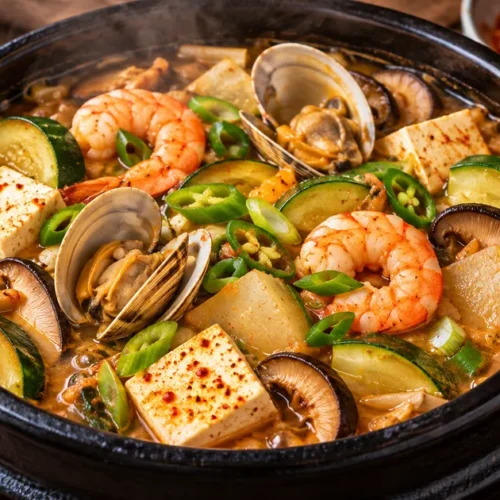
Seafood Doenjang Jjigae with Shrimp and Clams
Ingredients
- 4 cups unsalted anchovy-kelp broth prepared in advance; check packaged broth ingredients
- 3 tbsp Korean doenjang fermented soybean paste; check brand-specific salt content
- 1 cup Korean radish or daikon thinly sliced, about 4 oz
- 1/2 medium onion thinly sliced
- 1 small zucchini approximately 1 cup, cut into bite-size half-moons
- 1 cup mushrooms sliced, about 3 oz
- 8 oz medium-firm tofu cubed
- 2 cloves garlic finely minced
- 1/2 tsp gochugaru optional Korean chili flakes
- 12 small live littleneck clams cleaned and scrubbed; purged in advance if supplier requires
- 8 oz raw shrimp peeled, deveined and thawed if previously frozen
- 2 scallions thinly sliced; use clean cutting board
- 1 tsp rice vinegar optional; stir in at the end
Instructions
- Stir the unsalted anchovy-kelp broth and doenjang together in a medium heavy pot until the paste dissolves. Add thinly sliced radish and onion. Bring to a steady simmer and cook about 8 minutes, until the radish begins to soften.
- Add the zucchini, mushrooms, tofu, minced garlic and optional gochugaru. Simmer roughly 4 minutes, stirring gently so the tofu stays intact.
- Add properly cleaned live clams and cover. Simmer approximately 4–6 minutes, checking for shells to open. If some finish early, transfer them with clean utensils to a covered warm bowl. Discard any clams that remain closed after cooking.
- Add the raw peeled shrimp to the gently simmering broth. Cook for several minutes until their flesh becomes firm, pearly and opaque throughout. Extend cooking as necessary, then return the fully cooked clams to the hot stew.
- Add sliced scallions and optional measured rice vinegar. Divide promptly among four warm bowls and serve hot.
Notes
Ingredient decisions and practical substitutions
The defining ingredient is Korean doenjang. Substituting Japanese miso, generic bean sauce or an unfamiliar paste changes the seasoning. Because brands differ in concentration and sodium, do not add a large dose of soy sauce or salt before tasting the finished broth. Start with the measured doenjang and unsalted stock and adjust only if needed.
The seafood combination is deliberate. Shrimp and live clams have different cooking requirements, so they go into the pot separately. A bag of mixed frozen seafood may combine precooked pieces with raw pieces and would require another cooking sequence. If you want to use mussels or make a shrimp-only version, adjust the quantities and cooking checks rather than following this card unchanged.
For the vegetables, the radish, zucchini, mushrooms, and tofu all have defined places in the pan. Their amounts also influence the four-serving yield; doubling the tofu or replacing most of the broth with extra vegetables would alter the stew’s thickness. An optional half teaspoon of gochugaru changes heat, not the main soybean-paste ratio. The optional teaspoon of rice vinegar can be added after the seafood is done if a slightly sharper finish is desired; it is not an unmeasured invitation to add more liquid throughout cooking.
What to serve with the stew
Steamed rice is a natural side for a savory soybean-paste broth, but rice preparation is separate from the 45-minute estimate here. If serving rice, start with already-cooked rice or schedule its cooking independently. A small side of simply prepared vegetables can complement the stew without turning the main recipe into a second, competing preparation. Four bowls of soup are the card’s stated yield; the number of accompanying side dishes is outside that calculation.
Use broad bowls so each serving can receive shrimp, clams, tofu, vegetables, and broth. When sharing from the cooking pot, use a clean serving ladle and make sure opened clam shells are accounted for. The broth’s salt level will depend partly on the exact doenjang and stock used, which is another reason to retain the unsalted-stock condition in the recipe. A short serving description helps readers recognize the stew’s components without making unverifiable taste-test promises.
For another Korean-style dish on SABSEA, see our easy kimbap recipe for beginners. Kimbap is a separate rice-roll preparation rather than a variation of this stew, so prepare it as a different meal.
Food safety, allergens and leftovers
This soup contains several distinct allergens. Doenjang and tofu contain soy; the shrimp are crustacean shellfish, clams are molluscan shellfish, and the anchovy stock contains fish. Additional packaged ingredients can contain other allergens, so the actual labels control. Anyone who needs to avoid one of these ingredients should not rely on an unsourced claim that the broth is automatically free of it. Maintain separate utensils for raw seafood and washed scallion garnish, and wash surfaces after handling the shellfish.
Keep seafood refrigerated before preparation and serve the finished stew promptly. The FDA’s safe food-handling guidance calls for prompt refrigeration of perishables within two hours, or one hour when the air temperature exceeds 90°F (32°C). Transfer any leftovers to shallow containers so they cool promptly, and keep them refrigerated at 40°F (4°C) or below. Follow any earlier use-by or after-opening condition on the seafood packages rather than extending a shorter manufacturer limit to a general leftovers maximum.
Reheat leftovers thoroughly to 165°F (74°C) as covered in FDA food safety guidance. Expect the shrimp and tofu to change texture on reheating; food safety and quality are distinct questions. Do not repeatedly leave the pot out for serving and return it to the refrigerator for another round. Seafood that was mishandled before cooking cannot be made reliably safe merely because the stew comes back to a boil. The recipe’s starting-product and cleaning conditions matter as much as its finishing instructions.
Frequently asked questions
Is seafood doenjang jjigae the same as miso soup?
No. This recipe uses Korean doenjang, a fermented soybean paste, with vegetables, tofu, shrimp, and clams. Substituting Japanese miso would change the seasoning and the recipe. The dish is also organized as a substantial stew, not just broth with a small garnish. The exact strength of doenjang varies by product, so the measured paste and unsalted-broth ratio provides the working baseline.
Can I use frozen shrimp?
Yes, provided the shrimp are raw, properly handled, and completely thawed in the refrigerator before preparation. The stated timing assumes thawed, peeled, deveined shrimp, not a frozen block added directly to the hot pot. Check doneness when the shrimp are pearly and opaque and extend cooking if necessary. If the purchased shrimp are precooked, they need a separately validated reheating sequence rather than these raw-shrimp instructions.
What if some clams do not open?
Discard clams that remain closed after cooking. Before cooking, also discard cracked shells and open shells that do not close when tapped, and follow the supplier’s shellfish handling directions. The recipe’s brief cooking-time estimate does not override these checks. If the provenance or treatment of the clams cannot be verified, choose an appropriately labeled product and revise the recipe rather than guessing.
Can I replace the anchovy-kelp broth with water?
Water is an alternative base, but it will not offer the same seafood depth as the measured anchovy-kelp stock. For this recipe, use four cups of prepared, unsalted stock. Different doenjang brands vary in sodium, so assess the finished broth rather than adding a fixed extra quantity of salt.
Is the 45-minute time guaranteed?
No. The estimate is roughly 20 minutes of preparation and up to 25 minutes of stovetop cooking with ready-made stock, thawed shrimp, and clams already purged as required. Making stock, thawing seafood, or additional clam purging takes time outside the stated window. Shellfish cooking should finish according to the seafood’s safe endpoint, not a fixed minute count.
A measured stew worth keeping distinct
A measured broth and a vegetable-first cooking order make this Korean-style shrimp-and-clam stew easier to prepare. Start with ready-made unsalted stock, thawed shrimp and properly cleaned live clams so the preparation matches the stated timing. Serve the four bowls promptly, keep raw-seafood tools separate from clean garnishes, and let the seafood’s actual cooking checks—not only the clock—determine when the stew is ready.