
Grilled Whole Sea Bream with Lemon and Herbs
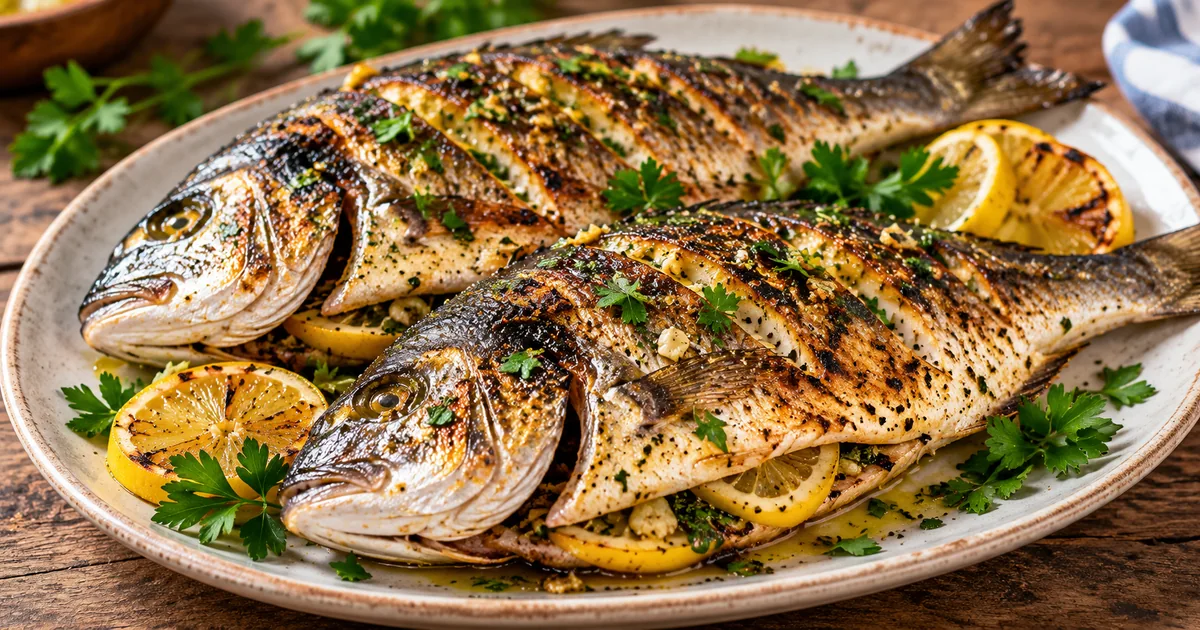
Grilled sea bream needs a more specific method than a general promise of crispy skin. This recipe uses two whole, already-scaled and gutted gilthead sea bream, each weighing about 1 to 1¼ pounds (450–570 g), plus a measured olive-oil coating and a clean lemon-parsley dressing added after grilling. The fish remains the main ingredient: no heavy marinade, wine or alcohol-based sauce is required. This is a two-serving main course when paired with a vegetable or grain side.
Fish size and grill equipment change the cooking time. A suggested 15–20 minutes on a preheated grill is a planning estimate, not a guarantee of doneness. Check the thickest flesh away from the backbone with a food thermometer, and continue cooking until it reaches 145°F (63°C). If the skin colors before the center is done, move the fish to a cooler part of the grill to finish rather than trusting appearance alone.
The recipe deliberately separates the oil and seasonings that touch raw fish from the lemon dressing used at the table. That small step protects the fresh finish from cross-contamination and keeps the lemon bright instead of cooking its flavor away. The formula below is an original editorial preparation designed for further kitchen validation; it is not described as a personally tested recipe.
Table of Contents
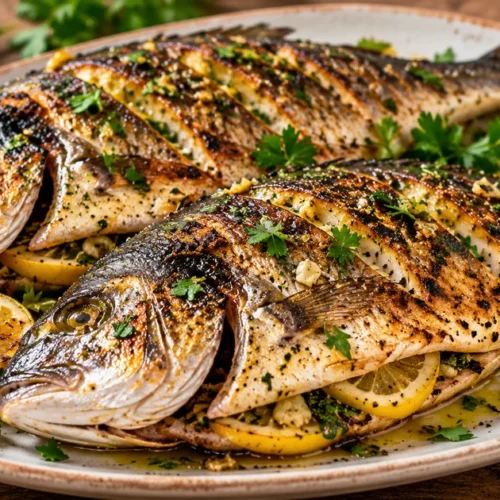
Grilled Whole Sea Bream with Lemon and Herbs
Ingredients
- 2 whole cleaned and scaled gilthead sea bream about 1–1¼ lb (450–570 g) each, gutted and fully thawed
- 2 tbsp extra-virgin olive oil divided: 1 tbsp for raw fish and 1 tbsp in separate clean dressing
- 1 lemon about 1 tbsp fresh juice, 1 tsp finely grated zest, and remaining wedges
- 1 small clove garlic finely grated for raw-fish coating
- 2 tbsp chopped flat-leaf parsley divided: 1 tbsp for coating, 1 tbsp for clean finish
- ¾ tsp kosher salt different salt brands/types vary in volume
- ¼ tsp freshly ground black pepper
- 2 small sprigs fresh thyme optional, one per fish cavity
Instructions
- Start with two fully thawed fish that a fishmonger has scaled and gutted. Keep them refrigerated until preparation. Pat the skin and cavities dry with clean disposable towels and keep raw fish separate from clean garnishes.
- Preheat a clean outdoor grill to medium-high heat, with a cooler area available if practical. Mix 1 tbsp olive oil, the grated garlic, 1 tbsp parsley, ¾ tsp kosher salt and ¼ tsp pepper. Coat the fish inside and out; place an optional thyme sprig in each cavity. Keep this raw-fish coating and its utensils away from the finishing dressing.
- Grill the fish for roughly 7–10 minutes on the first side, turn carefully using a basket or suitable fish spatula, and cook roughly 7–10 minutes on the second side. These are estimates; if the skin colors too quickly, use the cooler grill area. Check both fish in the thickest flesh away from bone and continue until each reaches 145°F (63°C).
- In a separate clean bowl, combine the remaining 1 tbsp olive oil, approximately 1 tbsp lemon juice, 1 tsp finely grated lemon zest and the remaining 1 tbsp parsley. Neither this dressing nor its utensils should touch the uncooked fish.
- Move the fully cooked fish to a clean platter and discard any uncooked coating that touched raw fish. Spoon over the clean lemon-parsley dressing, add the reserved lemon wedges and serve promptly. Take care when serving whole fish because it contains bones.
Notes
Why grill whole sea bream instead of baking it?
Whole gilthead sea bream has skin and bones that help keep the flesh together during grilling. This version is deliberately specific about species, size, and a short ingredient list rather than treating every type of whole fish as interchangeable. An existing SABSEA general whole-grilled-fish article discusses a broader category, while the separate published sea-bream guides use an oven. Here the method is an outdoor grill and the end point is a measured center temperature, not a particular skin color or number of minutes.
The lemon-and-herb finish is also part of that difference. It is made in a clean bowl and applied only after the fish has reached its safe cooking temperature. Garlic belongs in the pre-grill coating and the cavity; chopped parsley and lemon juice are reserved for the fresh dressing. There is no need to hold an acid-heavy marinade on the raw fish for hours, or to imply that extra seasoning will compensate for poor-quality seafood.
Gilthead sea bream is sometimes labeled dorade or orata, depending on the shop. Ask your fishmonger which fish is being sold and choose two similarly sized specimens. The approximate cooking window below applies to that stated weight range; fillets and substantially larger whole fish need their own timing and should not be substituted without adjusting the method.
The measured ingredient plan
For two main portions, buy two whole gilthead sea bream weighing about 1 to 1¼ pounds (450–570 g) each after the fishmonger has scaled and gutted them. Ask for them to be cleaned and ready for grilling. Use 2 tablespoons extra-virgin olive oil in total: 1 tablespoon for the raw fish and 1 tablespoon kept separate for the dressing. This split is intentional; a bowl, spoon or brush that touches raw fish must never go straight into a ready-to-eat finishing sauce.
The other measurements are 1 lemon (about 1 tablespoon juice, 1 teaspoon finely grated zest, and remaining wedges), 1 small garlic clove, 2 tablespoons chopped flat-leaf parsley divided equally, ¾ teaspoon kosher salt and ¼ teaspoon freshly ground black pepper. Two small thyme sprigs are optional for the cavities. Kosher salt crystal size varies by brand, so a different salt type is not necessarily a volume-for-volume substitute. No nutrient totals are claimed for this editorial formula.
The garlic, 1 tablespoon olive oil, salt, pepper and the first tablespoon of parsley form a light coating for the raw fish. The second tablespoon of olive oil, lemon juice, zest and remaining parsley form a fresh dressing in a clean bowl. If the lemon is unusually dry, use a second lemon rather than changing the ratio with an unmeasured splash of bottled concentrate. Lemon wedges remaining from the fruit can be served on the platter.
Keep the seasonings simple when shopping. Plain olive oil, herbs, fresh lemon and ordinary garlic are enough here. If choosing packaged seasonings or a prepared seafood product, read actual ingredient and allergen labels rather than assuming that every formulation is free of alcohol-based additives or other unwanted ingredients. This recipe does not include wine, cooking wine or spirit-based glazes.
Buying, chilling and preparing the fish
Choose fish displayed under proper refrigeration or over sufficient fresh ice at the market. The U.S. Food and Drug Administration advises keeping seafood refrigerated at 40°F (4°C) or below and using fresh purchases promptly; if the fish will not be used within two days, freeze it correctly. A fishy, sour, rancid or ammonia-like odor is a reason not to use seafood. A clear-looking eye or attractive skin can be useful shopping context, but appearance alone cannot verify safety.
Begin with already-cleaned fish to keep this recipe realistic for a weekday cook. If it was frozen, thaw it safely in the refrigerator first. The 15-minute active preparation estimate does not include the extended time needed for frozen fish to thaw. Keep fish cold while measuring the dressing and heating the grill, and avoid leaving raw seafood unattended on a warm counter during the preparation period.
Dry the outer skin and cavity with clean disposable kitchen towels. This helps the light coating adhere and avoids taking unnecessary extra water to the grill. Use separate clean bowls and utensils for uncooked fish and ready-to-eat garnishes, and wash hands and food-contact surfaces between tasks. Do not return grilled fish to the dish that carried it to the grill unless that dish has been thoroughly cleaned.
The recipe does not depend on deep skin cuts or a complicated stuffing. Add the measured garlic and first tablespoon of parsley to the olive-oil coating, season both fish inside and out, and tuck an optional thyme sprig into each cavity. Keep the finished lemon-parsley mixture well away from this raw-fish station. These ordinary preparation details matter more to a dependable recipe than decorative grill marks.
Grilling sequence and the 145°F endpoint
Preheat a clean grill to medium-high heat and prepare a cooler cooking area if the equipment permits. Exact grate temperatures and cooking rates vary with the grill, air temperature, fish shape and starting temperature; the recipe therefore offers a time window rather than claiming that every one-pound fish is finished in a fixed number of minutes. A clean fish basket may help hold two whole fish together during turning, especially if the grates are widely spaced.
Coat the fish with the measured raw-fish mixture and place them on the preheated grill. Allow roughly 7–10 minutes on the first side before carefully turning, then roughly 7–10 minutes on the second side as an initial guide. Turn only when the skin releases without force; a basket can simplify this step. If the surface browns rapidly, use the cooler zone to continue cooking rather than leaving the fish over the highest heat to achieve a darker crust.
Near the estimated finish, insert a clean food thermometer into the thickest part of the fish without contacting the backbone. Cook until the thickest flesh reaches 145°F (63°C); check both fish because matching purchase weights do not guarantee matching thickness. The FDA notes that fully cooked fish is also opaque and separates easily with a fork, but temperature is the more reliable check when a suitable thermometer can be used. A fast-colored skin or a fish that looks plated for a photograph is not evidence of a safe center.
Transfer fully cooked fish to a clean serving platter. Discard any uncooked coating or leftover oil that contacted the raw fish. Combine and spoon over the separately prepared lemon-parsley dressing only at this point. Add the reserved fresh lemon wedges and serve promptly. Never pour a raw-fish marinade over cooked seafood as if it were a fresh sauce; if a sauce has contacted uncooked seafood, it requires separate food-safety handling and should not be treated as the ready-to-eat dressing specified here.
Lemon, parsley and serving ideas
Whisk the clean dressing from 1 tablespoon extra-virgin olive oil, approximately 1 tablespoon fresh lemon juice, 1 teaspoon finely grated lemon zest and the remaining tablespoon of chopped flat-leaf parsley. Make it in a clean bowl before the fish goes on the grill and keep it separate until serving. This amount adds freshness without hiding the natural flavor of the sea bream. Taste it before serving; if your lemon is especially sharp, add a small portion at a time rather than automatically pouring every drop on the fish.
Each fish is designed as one main-course portion with side dishes. A tomato-cucumber salad, plain rice, grilled zucchini or potatoes can make a complete meal without turning the fish into a sauce-heavy preparation. The skin may be appealing to some readers, while others prefer the carefully removed cooked flesh. A whole fish still contains bones, so alert diners and take particular care when serving children.
For another grilled-fish dish built around a distinct herb seasoning and a different species, see our Grilled Sardines with Chermoula. This related link is intended to help readers choose a different preparation, not to imply that the two fish or cooking methods can be swapped without altering time and handling.
Variations, equipment and realistic timing
A clean fish basket is a practical option for a whole fish that might otherwise catch on widely spaced grates. A wide fish spatula may work on a grill with close-set bars, but the basket does not change the temperature target. A ridged indoor grill pan is a separate appliance with its own heat distribution and should not be assumed to match the outdoor grill times in the recipe card. Readers using another device should follow its instructions and still verify the thickest-flesh endpoint.
The optional thyme changes the aroma but does not change the amount of fish or the lemon dressing. Parsley can be omitted if unavailable, although the recipe’s named lemon-and-herb finish will then be less prominent. Do not add a mystery store-bought marinade merely to raise the flavor count. An explicitly alcohol-free preparation and measured ingredient list are central editorial constraints for this version.
The proposed 35-minute total is divided into 15 minutes of active preparation and approximately 20 minutes at the grill. It presumes the fish is already gutted, scaled, fully thawed and ready to cook, and the grill preheat can overlap some of the preparation. A larger specimen, lower heat or interrupted grilling will require more time. If the thickest flesh has not reached 145°F at the estimated end, continue cooking until it does rather than letting the displayed clock override the food thermometer.
Food safety, allergens and leftovers
Keep raw fish separate from ready-to-eat lemons and herbs. Clean hands, surfaces and utensils after raw handling, and use a completely separate clean bowl for the finishing dressing. The FDA seafood selection and serving guidance advises refrigerated storage at or below 40°F (4°C), safe thawing, careful separation and cooking most seafood to 145°F (63°C). Its guidance also cautions against relying on smell alone or serving spoiled seafood after cooking.
If there are leftovers, cool and refrigerate them promptly, within two hours of preparation or within one hour when the ambient temperature exceeds 90°F (32°C). Store cooked fish in a shallow covered container, apart from raw seafood, and use refrigerated leftovers within three to four days. Reheat leftovers thoroughly to 165°F (74°C) according to the FDA safe food handling temperature chart. An open-air summer meal should not be used as a reason to leave cooked fish unrefrigerated for the afternoon.
Sea bream is finfish and is a relevant fish allergen. The recipe also contains garlic and herbs, which should be listed accurately for readers with individual dietary restrictions. Verify any packaged product you use against its real ingredient label. Do not make universal allergen-free, medical, weight-loss or nutrition claims; ingredients and product handling matter more than an unsupported health slogan.
Frequently asked questions
Can I use sea bream fillets instead of whole fish?
You can prepare fillets as a separate variation, but this particular method and approximate time are written for two whole gilthead sea bream of the stated weight. Fillets cook differently and may need a fish basket or a different technique. In either case, verify the correct cooked-fish endpoint.
Should the lemon juice go on before grilling?
This version reserves the measured lemon juice for a clean dressing added after cooking. Garlic and parsley season the fish before it goes on the grill, while the fresh lemon dressing stays separate from all raw-fish utensils and surfaces.
How do I know that the center is cooked?
Use a clean food thermometer in the thickest flesh away from the backbone and cook both fish to 145°F (63°C). Skin color and the clock alone cannot establish that the center is fully cooked.
Will a fish basket change the recipe?
It may make turning a whole fish easier, but it does not change the ingredient quantities or safe internal temperature. Grill time can still vary with the equipment and fish thickness.
How should I store leftover grilled sea bream?
Refrigerate it promptly in a shallow covered container within two hours, or within one hour above 90°F (32°C). Use refrigerated cooked leftovers within three to four days and reheat thoroughly to 165°F (74°C).
A clear finishing point
This recipe puts the variable that matters most—the center of the fish—before any promise about skin color or exact minutes. Buy two similarly sized precleaned gilthead sea bream, measure the light coating, keep the finishing dressing separate, and use a thermometer to confirm the thickest flesh has cooked through. These steps provide a transparent basis for the editorial recipe; practical kitchen validation would still be needed before claiming a personally tested result.
—