
Grilled Halibut with Thai Red Curry Glaze
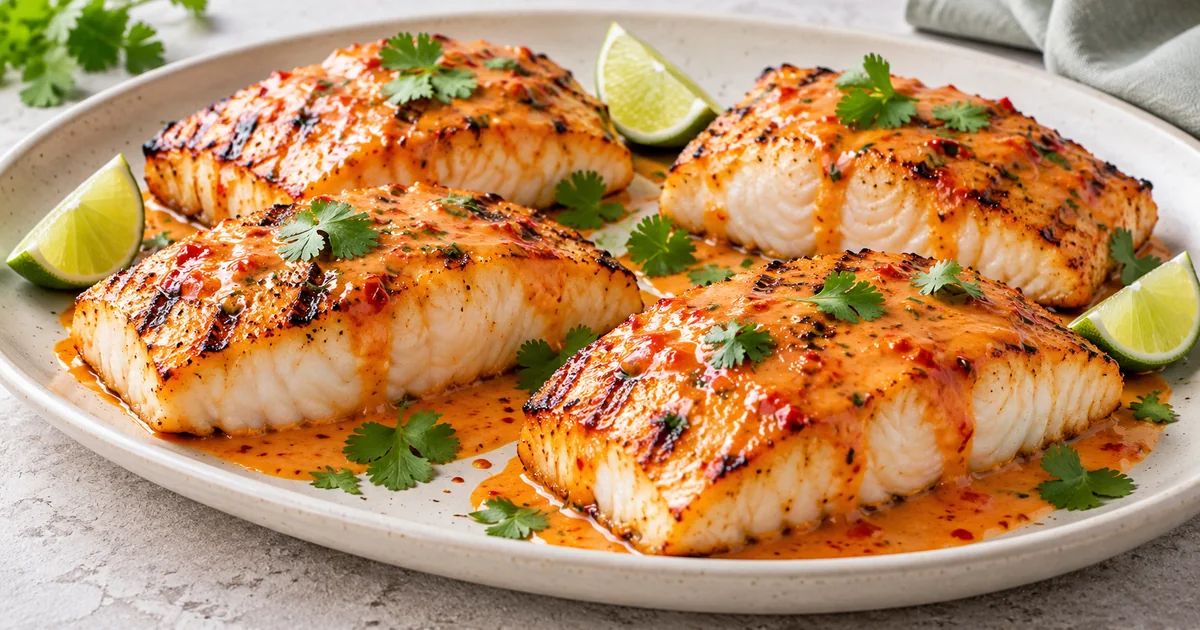
Grilled halibut with Thai red curry glaze offers a specific way to season thick white-fish fillets without turning them into a long-marinated dish. A small saucepan of coconut milk, labeled Thai red curry paste, garlic, ginger and lime becomes a lightly spoonable glaze. Part of that cooked sauce goes into a separate dish for brushing the fish; the rest stays untouched for serving. The distinction matters because the brush and its portion of glaze may touch fish that has not finished cooking.
This version is written for four halibut fillets of about 5–6 ounces (140–170 g) each and approximately 1–1¼ inches (2.5–3 cm) thick. The fillets are lightly oiled, grilled directly over medium-high heat, and brushed with a modest amount of red curry glaze during the final part of cooking. Their safe finishing point is determined with a food thermometer rather than a promise that every grill will finish in the same number of minutes.
Unlike a general grilled-halibut recipe, the sauce is the reason to choose this dish. The coconut milk softens the curry paste’s concentrated flavor, a measured amount of brown sugar balances its salt and heat, and lime is stirred in after simmering. This is Thai-inspired rather than a claim to one universally authentic Thai preparation. If a herb-and-butter preparation sounds more appropriate, our separate grilled halibut with cilantro garlic butter uses a different sauce; the present recipe is deliberately about a coconut-red-curry glaze.
Table of Contents
Why Grilled Halibut with Thai Red Curry Glaze Works
Halibut is a mild, firm white fish, so a short period of direct grilling can leave the fillet recognizable beneath its seasoning. A thick marinade left on fish for hours is not needed for this approach. Instead, concentrated curry paste is briefly cooked with aromatics, loosened with coconut milk and simmered into a glaze. It coats the surface toward the end of grilling while a separate clean portion can be offered at the table. This also avoids asking readers to save a marinade that has touched raw seafood.
The red curry paste matters more than a long list of unmeasured spices. Commercial pastes can vary considerably in chili heat, salt content, seafood ingredients and added flavorings, so the two tablespoons should be treated as a measured starting point for a specific labeled product, not a universal heat guarantee. Check the entire label before choosing a paste. Some contain shrimp paste or fish-derived ingredients; these affect allergens and whether the product suits particular dietary requirements. Choose one whose actual label meets your household’s ingredient requirements, including the absence of alcohol-based additions.
The coconut milk in this recipe is plain and unsweetened. It supplies liquid to distribute the paste and creates a coating that can be brushed lightly rather than poured onto the grill. Garlic and fresh ginger go into the saucepan with the paste, while lime juice is stirred in after the heat is turned off. Cooking the lime for a prolonged time is unnecessary. The resulting sauce is intended as a glaze, not a large-volume curry served over the fish.
Ingredients and product choices
Start with four boneless halibut fillets, each roughly 5–6 ounces and 1–1¼ inches thick. If yours are much thinner, they can reach the required center temperature sooner; significantly thicker pieces may need more cooking time. If the fillets were frozen, thaw them safely in the refrigerator before the recipe’s clock starts. Pat the surface dry with disposable kitchen paper so that excess water does not dilute the glaze or make handling the fish more difficult on the grate.
For the glaze, measure two tablespoons of commercial Thai red curry paste, half a cup of unsweetened coconut milk, one finely minced garlic clove, one teaspoon of grated fresh ginger and two teaspoons of light brown sugar. Add one tablespoon of freshly squeezed lime juice after simmering. Divide one tablespoon of neutral oil: one teaspoon goes into the saucepan for the aromatics and the remaining two teaspoons lightly coat the fish and grate as needed. Up to a quarter teaspoon of kosher salt can be applied sparingly to the fillets, depending on the salt level printed on the paste label. Two tablespoons of chopped fresh cilantro are an optional garnish; they are not part of the glaze’s cooking process.
Avoid silently replacing the specified coconut milk with sweetened cream of coconut, which would change both sweetness and thickness. A purchased curry paste may also already contain garlic, lemongrass, seafood or other seasonings, but the fresh garlic and ginger specified here are the consistent baseline for this recipe. Additional bottled sauces are not required. In particular, the recipe does not call for wine, cooking liquor or an unidentified restaurant sauce whose ingredients cannot be checked.
Make the glaze before the fish reaches the grill
Set out two clean small bowls before handling any raw fish. Put one teaspoon of the measured neutral oil into a small saucepan over medium-low heat and briefly warm the garlic, grated ginger and two tablespoons of red curry paste, stirring so that the mixture does not catch. Add the half cup of coconut milk and two teaspoons of brown sugar. Stir and bring the sauce to a gentle simmer. Continue for roughly four to five minutes, stirring, until the paste is evenly dispersed and the sauce coats a spoon lightly. The final thickness will vary with the coconut milk and the paste, so avoid reducing it to a sticky paste that would burn on the grill.
Take the saucepan off the heat, then stir in one tablespoon of fresh lime juice. At this point the complete sauce has not touched raw fish. Spoon approximately two tablespoons into a small bowl specifically for brushing the fillets. Put the rest into a separate clean bowl with its own clean spoon for the finished dish. Keep the reserved serving bowl away from the raw-fish workstation. Once the brushing portion has contacted the fish or a brush that touched it, do not return it to the serving bowl or use its leftovers as an uncooked finishing sauce.
This division is the essential preparation step, not an optional styling detail. The U.S. Food and Drug Administration warns against using marinades that have touched raw seafood on cooked food unless they are brought to a boil. Preparing the whole sauce first and separating the portions before any contact eliminates that particular reuse problem. If you unexpectedly need more glaze while grilling, use a clean spoon to transfer it into the brushing bowl without letting a contaminated brush touch the reserved serving sauce.
Grill the halibut and check its center temperature
Heat a clean grill to medium-high, approximately 400–450°F (205–230°C) at the grate if a grill thermometer is available. Clean the grate and oil it carefully with a suitable grill-safe method to reduce sticking. Use the remaining two teaspoons of neutral oil to coat the patted-dry halibut lightly, and add a little of the measured salt only if the curry paste’s label and your tastes warrant it. Have a clean serving platter, clean tongs or fish spatula, and a food thermometer ready before the fish goes on.
Set the fillets on the grill without crowding. For pieces around 1–1¼ inches thick, allow roughly four to six minutes on the first side before trying to turn them once with a wide fish spatula. If the fish resists, avoid tearing it by forcing a turn prematurely; heat and surface condition can affect release. After turning, use only the dedicated brushing portion of the cooked curry glaze to coat the exposed surface thinly during the final couple of minutes. A generous sugary coating too early in the process can scorch instead of glazing the fish.
Continue cooking until a clean thermometer reads 145°F (63°C) in the thickest part of each fillet. Check the center, not merely the thinner tail end, and treat an approximate eight-to-twelve-minute grilling window as a planning estimate rather than proof of doneness. Actual timing depends on the fish’s thickness, starting temperature and grill. If a surface browns before the center is ready, move the fillets away from direct high heat to finish more gently. Transfer cooked fish to the clean serving platter, never the unwashed plate used for raw fillets.
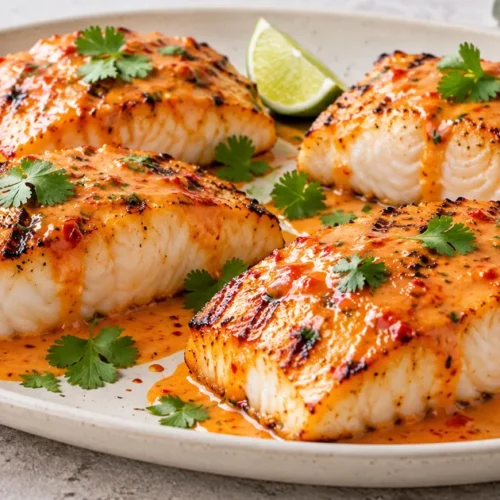
Spoon the untouched reserved glaze over the cooked halibut or serve it alongside, using only its dedicated clean spoon. If desired, sprinkle the measured chopped cilantro just before bringing the dish to the table. Any brushing sauce that remained in the bowl after it contacted raw fish or the contaminated brush should be discarded rather than mixed with the clean sauce. The fish should be served promptly; keeping it in a warm grill for an extended period can compromise its texture.
What to serve with Thai red curry halibut
The glaze is concentrated, so plain steamed jasmine rice is a logical serving accompaniment: it absorbs a little of the reserved sauce without adding another competing dressing. Rice is an optional side, not included in the four-portion fish recipe or its preparation time. Steamed green beans, sautéed zucchini or simply cooked broccoli also offer contrasting textures. Choose an accompaniment that can be prepared with separate, clean utensils while the fish is on the grill.
If serving several people with different heat preferences, present the untouched reserved glaze in a small bowl instead of automatically spooning it all onto every fillet. This gives diners some control over the intensity without changing the fish’s cooking endpoint. Since paste brands have different salt and chili levels, taste the fully cooked glaze before brushing the raw fish and make any reasonable adjustment at that clean stage. Do not taste the brushing bowl later to decide whether it needs more seasoning.
A little cilantro is optional; leaving it out keeps the recipe workable for those who dislike the herb. Lime wedges can be offered separately, but they are serving extras rather than substitutes for the tablespoon of juice measured in the glaze. Keep the dish firmly in its lane as a grilled fish recipe. It is not a soup, a foil-packet fish dinner or a pan full of curry sauce, and the page should not imply that following this method produces those other dishes.
Storage, seafood safety and advance preparation
Buy halibut from a reliable seller and keep it refrigerated at 40°F (4°C) or below. According to the FDA, seafood intended for use within two days of purchase should be stored promptly in the refrigerator; otherwise freeze it appropriately. Thaw frozen fish in the refrigerator ahead of time, not on a kitchen counter. Wash your hands and clean utensils and work surfaces after handling raw seafood, and keep the clean finishing-sauce bowl and cooked-food platter in a separate area.
The FDA recommends cooking finfish to 145°F (63°C). A thermometer reading in the thickest part of the fish takes priority over appearance alone or any fixed number of grill minutes. Keep all raw-contact utensils out of the reserved serving sauce. The FDA also advises refrigerating seafood and other perishables promptly and not leaving them at room temperature for more than two hours, or more than one hour when the temperature exceeds 90°F (32°C). Use shorter product-specific instructions when the packaging requires them.
You can mince the garlic, grate the ginger and measure the coconut milk ahead of time, keeping anything perishable properly chilled. The glaze can be prepared separately before handling the raw fish; if making it far in advance, cool and refrigerate it promptly, then reheat appropriately before dividing into serving and brushing portions. The stated thirty-two-minute planning total assumes the halibut is already thawed, the grill is ready and the ingredients are measured. It does not include lengthy refrigerator thawing or cooking rice as a separate side dish.
Food-safety reference: FDA guidance on selecting and serving seafood safely. Raw-contact sauce reference: FDA guidance on separating raw seafood and handling marinades.
Grilled Halibut with Thai Red Curry Glaze
Ingredients
- 4 5–6 oz fillets boneless halibut about 140–170 g each, roughly 1–1¼ inches thick, fully thawed
- 2 tbsp commercial Thai red curry paste check exact label for seafood allergens and ingredients such as alcohol-based additives
- 1/2 cup unsweetened coconut milk not sweetened cream of coconut
- 1 tbsp neutral cooking oil divided: 1 tsp for glaze, 2 tsp for fish
- 1 large clove garlic finely minced
- 1 tsp freshly grated ginger
- 2 tsp light brown sugar
- 1 tbsp fresh lime juice stir into sauce off heat
- 1/4 tsp kosher salt up to 1/4 tsp, sparingly according to salt already in paste
- 2 tbsp chopped fresh cilantro optional garnish
Instructions
- With four fully thawed halibut fillets patted dry, assemble and measure the ingredients and set out two separate clean sauce bowls. Prepare clean grilling and serving utensils before handling raw fish.
- Heat 1 tsp neutral oil in a small saucepan over medium-low. Stir in the garlic, ginger and 2 tbsp red curry paste briefly. Add 1/2 cup coconut milk and 2 tsp brown sugar; simmer gently about 4–5 minutes, stirring, until lightly spoonable. Remove from heat and stir in 1 tbsp lime juice.
- BEFORE any sauce touches raw fish, transfer about 2 tbsp cooked glaze into a dedicated brushing bowl. Pour the remaining clean sauce into a second untouched bowl for serving, with its own clean spoon. Never return the raw-contact brush or any used brushing sauce to the serving bowl.
- Preheat a clean grill to medium-high, about 400–450°F (205–230°C). Oil the clean grate appropriately. Lightly coat four patted-dry fillets with the remaining 2 tsp neutral oil and season sparingly with up to 1/4 tsp kosher salt according to the paste label. Grill roughly 4–6 minutes on the first side, turn once, then grill about 4–6 minutes more. During the final 2–3 minutes, brush thinly using only the dedicated brushing portion. Cook each fillet until its thickest center reaches 145°F (63°C); temperature, not clock time, determines doneness.
- Transfer the cooked fish to a fresh clean platter. Spoon over or offer the untouched reserved glaze with its own clean spoon, and garnish with up to 2 tbsp chopped cilantro if desired. Discard any used raw-contact brushing sauce and serve promptly.
Notes
Frequently asked questions
Can I use the glaze as a marinade overnight?
This recipe is designed for a brief, separate finishing glaze, not an overnight marinade. Cook the glaze, reserve a clean portion for serving before any raw contact, and brush from a dedicated second bowl during the final part of grilling. An overnight marinade would need a different method and timing.
How do I keep the red curry glaze from burning?
Use medium-high heat rather than an uncontrolled flame, and brush a thin layer only toward the end of grilling. Coconut milk and brown sugar can brown rapidly on a very hot grate. If the exterior darkens before the center reads 145°F, move the fish to a gentler heat zone to finish.
Is Thai red curry paste always suitable for people with seafood allergies?
No. Some commercial pastes contain shrimp paste or other seafood ingredients; recipes and manufacturing labels differ. Check the exact packaged product and its allergen statements before preparing the dish. Halibut itself is fish, a separate major allergen.
Can I use frozen halibut?
Yes, provided it is thawed safely and thoroughly in the refrigerator before preparation. Pat the fillets dry and use thickness and a clean thermometer, not a fixed timer, to judge their final 145°F center temperature. Refrigerator thawing time is not included in the recipe’s planning total.
What can replace the cilantro garnish?
The chopped cilantro is optional; omit it if preferred. The glaze’s defining ingredients are the labeled red curry paste, coconut milk, garlic, ginger, brown sugar and lime, so the fish does not depend on a particular garnish. Serve plain steamed vegetables or rice separately if desired.
A distinct grilled-halibut recipe to revisit
This recipe keeps one central technique consistent: a short-cooked red curry and coconut glaze is prepared before the halibut is grilled, then split into a raw-contact brushing portion and an untouched serving portion. A fresh food thermometer reading controls the fish’s endpoint. That is meaningfully different from our site’s broader grilled-halibut instructions, cilantro-garlic-butter preparation and foil-pack variation.